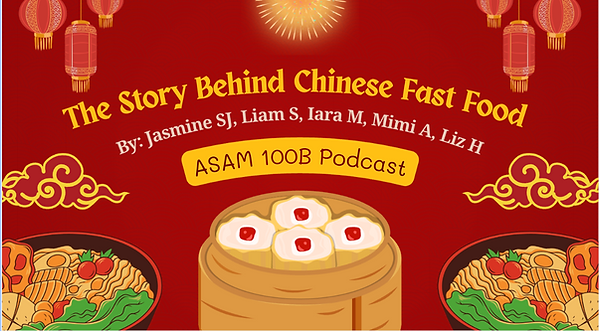
Our podcast goes over various aspects of Chinese food in America with a specific focus on the restaurants and how and why they differ from traditional Chinese food. We start with Panda Express, the largest Chinese-American fast food chain, and then discuss the overall history of these types of restaurants in the U.S., how they changed, why they’re where they are, and their cultural significance to Chinese-Americans and their culture.
Team.
Jasmine SJ
Liam S
Iara M
Mimi A
Liz H
Transcript
Liam 0:00-0:56 Hello, welcome to the Asian American 100B podcast. My name is Liam.
Iara 0:015-0:16 My name is Iara.
Liz 0:16-0:17 My name is Liz.
Jasmine 0:17-0:18 My name is Jasmine.
Mimi 0:18-0:20 And my name is Mimi.
Liam 0.20-0.57 Today we’re going to be talking about Asian American foods in the United States, specifically Chinese American food. And some of the history times; small restaurants, especially because of the idea that Chinese restaurants are on every street corner, we want to discuss why they’re so common. We’re also going to talk about Panda Express and how it specifically became such a huge Chinese American restaurant change. We’re also going to be talking about why certain Chinese restaurant owners decide to change their flavors to fit American taste, as well as the cultural significance of this kinda food. And to begin, we’re going to start with Jasmine, talking about Panda Express.
Jasmine 0:58-3:36 Yes, so a little backstory about Panda Express. You may wonder why this chain has a restaurant on every block on the corner. But actually started with two Chinese immigrants who came into the U.S in the 1960s. Andrew and Peggy Cheung moved to Kansas specifically, they first opened their first sit-down Chinese restaurant called Panda Inn. It was actually near us in California, in Glendale. Um, they just wanted to create a Chinese restaurant because they missed their home town in China, so they decided to open a Chinese restaurant in the area. But it was nothing fast-food, it was a pretty sit-down restaurant, nothing too casual. But that wasn’t until 1983 they opened their first Panda Express in the Glendale Galleria. So that’s a mall because they wanted to adapt their customer base. They noticed that many people weren't looking for a sit-down restaurant, so they wanted to adapt their market in a fast customer base. So that is why they named it Panda Express. Um, so their main competitor was actually local Chinese food, so in the 90s and the 80s, Japanese food was getting more popular than Chinese food. So they actually created their own chain restaurant to delete all the Japanese competitors. So you can see these two people really strive for money and success. And that's how they adapted, they just created their own competitors, and they saw that their customers weren’t looking for something more intimate, they wanted more casual, and they saw a competitor, Japanese food, and they decided to create their own Japanese competitors to knock their foods out of the market. But there are usually two sides to what people think of Panda Express. The two side Asian Americans think of is number one is that they think Panda Express is not traditional Chinese food and is a misrepresentation of Asian American culture. Like people go into Chinese restaurant and they ask, where is the orange chicken? And there like, we don't serve that. Because they think that Panda Express is the representation of Chinese food. Then there is another side that thinks Panda Express is not traditional Chinese food, and the founders even acknowledge that. So I just want to open the conversation space, do you guys have an opinion on that, or do you have a side that you lean towards? Do you think Panda Express is traditional Chinese food, or do you think it is a good awareness to have Chinese American food in the US?
Liam 3:37-4:37 I think I’ll go first, I’m going to speak so much on this, as a very very pale man. But I think that it’s kind of somewhere in between, either a full cultural appropriation and solid representation. Because I don’t think that the problem is inherently traditional Chinese food, it’s more that people make the assumption that it is. So because people aren’t aware of what traditional Chinese food is, they will go to Panda Express and then not only just assume like wow, this is like China, they will assume it’s ALL of Asia. They will just group it altogether because there’s that whole thing like “All Asians are the same”. And so if I go to Panda Express, I’m eating Asian food.” And I think that’s where the problem really comes from and not that, it’s not that it’s bad representation or good representation, it’s that people aren’t educated enough to be able to make anything out of it, that is a meaningful idea.
Jasmine 4:37-4:39 Does anyone else want to speak?
Mimi 4:40-6:07 Yeah, I also like, agree with Liam. I feel like, I actually personally don’t like Panda Express.. And maybe because. I really don’t, I feel like it wasn't my first impression of Chinese food. I have a local restaurant in my hometown that I would go too and they were more traditional with their dishes. Like when I tried Panda Express, I was like uhh, I feel like I can taste the sweeter flavor. I was like mmm, I don’t really like this. Um so, I don’t really like Panda Express but I do think that there is a problem and with, like you said Liam, assuming that is real Chinese food and not being aware of the history behind it. You know the merging of Chinese and Chinese American Food. And speaking of other foods, for example, Asian American foods; msg, spam, or california roll with japanese food. Those are all, well they were created in America, but still created by Asian people and they still have this Asian influence, and shouldn’t take away from the food itself, and not be considered Asian food. Because it’s still is and still a deep part of the culture, so yeah.
Jasmine 6:08-6:27 Yeah, I even agree, even the owners admit that Panda Express is not traditional Chinese food, and it's even a different category of American Chinese food. But thank you guys, so much for sharing your guys' opinions. But now we are gonna go into Mimi, she is going to talk about Chinese immigrants opening restaurants in the U.S.
Mimi 6:28-9:01 My section is the first thing I did when researching this topic while looking into “What was the first Chinese Restaurant that was opened in America? And how did they become so popular?” But moving away from fast food, I just wanted to get into the deep and early history and the transition from normal Chinese American sit-down restaurants to fast food chains. So the first Chinese restaurant in America was opened to immigrants and many immigrants at the time.. Asian Americans immigrants and people from all over the country, coming to America and trying to find a way to make a stable living and the restaurant industry was one of those ways. The idea of following American dreams is becoming successful which is very much a part of that. And while the restaurant industry is very prosperous, it was a laborious industry too. I think that a lot of people didn’t recognize that at the time. It’s also not considered, for immigrants to the general public, the industry wasn’t really seen or considered an ideal working space. It was successful and prosperous, it wasn’t ideal. Many immigrants that came into the industry, their main goal is get out of it and work for future generations to get out of that and go to school and things like that, getting out of that cycle. Speaking of that cycle, while the first immigrants came to America and opened these restaurants, they’re with incoming immigrants coming to open China Town and other things. Basically there was a cycle of exploitation induced by the first Chinese employers that would come to America, hiring new immigrant workers for cheap labor. Then you know, in turn was fueling this national expansion of the restaurant industry and so that’s where that cycle came from.
Liam 9:02-9:06 I want to say something. Dude, immigrants hiring other immigrants to exploit them is.. INSANE.
Iara 9:06-9:27 That's what I was thinking of. Like the cycle just keeps going, like it began from the Americans here doing it to them and then they kept it going on to like people. Immigrants more and they did it more and it just kept going so like it was a cycle that I feel like I don't know it wasn't that good, it's not a good thing to enter into.
Liam 9:29-9:38 Man this exploitation itself is just so profitable and it’s not happening to me anymore.. That’s so disappointing.
Mimi 9:42-9:54 But yeah, I think if we’re ready to move on from that topic, I’m going to introduce our next speaker Liam. Who’s going to be talking about Chinese American foods in different communities.
Liam 9:55-13:07 Yeah I’m going to be specifically speaking about the phenomenon of small Chinese restaurants being very very prevalent in Black communities. Because it’s kinda a strange idea that all these different ethnic groups will be so prevalent in a different neighborhood. But it’s actually because of the long history of racism and exclusionary policy. So when Chinese men began coming to the US to work, they were doing it to send money back to the relatives at home, and as Mimi described.. They started opening restaurants to start doing that because it’s a very easy way to make money, as well as because it was pretty straightforward. You make food, you sell the food. In the 60s, many Chinese immigrants started taking out loans, banks to open more and more restaurants because they couldn’t afford to do it on their own. But they couldn’t afford to register or not be allowed to do it in white neighborhood. The bank couldn’t give them loans if they’re trying to do that, so they were forced to take out high risk loans to open up businesses, Black communities. And this is a policy called red lining, it’s when you designate an area with a certain racial group as high risk to prevent extra investment in the area. So all these Asian Americans immigrants who were trying to open up restaurants were only able to take out loans in these areas to start their business. That’s why there’s so many Chinese restaurants in poor Black communities, and this created a lot of resentment between the two groups because Asian Americans were able to start businesses in Black communities when Black people were not able to start businesses in Black communities, they weren’t able to get the loans because either they were Black or not qualified or they thought Asian Americans were MORE qualified to take out these loans to start the businesses. So that means you have Black people's money going to non Black businesses and the businesses were owned by people who don’t even live in the neighborhood. So all this money being spent at these restaurants doesn't go back into the community or the neighborhood. And the frustration of this was very real from both sides. Asian Americans were racist to Black people and Black people were racist back. But these frustrations were really exasperated by outside groups; policy makers saw this phenomenon and tried to make it worse in order to get these groups together so they wouldn’t realize that they were both doing bad and that they shouldn’t be fighting against the white people. That’s where red lining comes in, they did that very much on purpose. The media was also very explicitly inflammatory in this. They would paint Black men as aggressive and dangerous, Asian Americans were helpless and unaware with the things that were happening. So that really made things worse and any small incident that may have happened, was talked about more and talked about worse from both sides. And it’s very interesting to see how just looking into the history of a certain type of restaurant could reveal so much about race dynamics and racial tensions between groups of people.
Jasmine 13:08-13:34 Yeah, I think that's pretty difficult, these two communities and these two ethnic groups. They are trying to be united, but the money and the socioeconomic class separate the two. It's kinda sad that these two ethnic groups have the same histories of coming to America, but cannot have peace with each other.
Mimi 13:34-14:31 I think there’s a flipside to that too because—I’m from the Bay Area—San Francisco and Oakland are very culturally diverse places, and you see a lot of culture crossing with San Francisco Chinatown and Oakland Chinatown. There are really cool ways and restaurants where we see cultures crossing, and the mix of Asian and Black flavors fusion. So, yes, while there is one side to the negatives, I think there’s something to be said about the positives too about where those communities and minorities come together.
Jasmine 14:31-14:45 Um but now we are going to introduce another topic. Iara is going to talk about traditional Chinese flavors and also American flavors because some people don’t know how to agree how some flavors are traditional Chinese and American foods.
Iara 14:45-17:00 Okay so chinese immigrants um came here, when they they opened their restaurants they tried to appeal to the American taste buds so their flavors were changed um changed um so ingredients used here are not actually used over there such as bok choy or water spinach which are not commonly found here and so they had to switch those to use more um ingredients like broccoli and um snow peas. Also another main reason why these tastes are so different is because in America we like greasy food. Like we love the greasy food and we like to dip our food into grease. We love to like I don't know we love the flavor in it and so it's a very different taste compared to China. While also the cooking style which is very very different. Here we like to um use a pan named wok. I don't know if I'm pronouncing it right and deep frying and sauteing. So I don't know what that is. I'm not into cooking, but I know it's a little different compared to China where they like to um boil, steam, and roast their food. So its like, there menus compared to here are distinct in ingredients and so the menus are very different and so in chinese restaurants when you walk in and your seen as an american they will give you an english menu and so like dishes here they will give you common ones like orange chicken chow mein like yeah the basics and so if you are coming here as a chinese customer your menu would be written as a chinese menu and they'll have more authentic food so you'll like see the difference. If you ask for it though, if you go to a chinese restaurant and you ask for a chinese menu they'll actually give it to you. You like, you get the authentic food, like if you want to, if you're interested you can ask for one. Okay so I have a question for you guys, What's your favorite Chinese American Dish, like do you guys have a favorite one?
Liz 17:18-18:27 So as a Cambodian Chinese, I grew up in a household where my mom makes a lot of food. All these foods contain ingredients like broccoli, a bunch of tames, herbs, and bok choy. For example, these vegetables in these foods gave a different taste in Chinese and American food. They both just have a very slight difference in taste. What I see from that, the taste can be tangy sometimes with Chinese food and not saying that it’s a bad thing but it is good. From my experience and stuff, there’s like Chinese food everywhere. I’ve been to China Town in LA. I don’t know if you guys have been there before but they have many food options and it’s so good. Especially the taste of it and stuff, it’s so different from what Chinese food in America is, like Panda Express for example.
Mimi 18:27-18:34 Do you have a favorite like from China, do you have like cause I think my favorite will always be Dim Sum.
Liz 18;34-18:36 Din oooh Din Tai Fung.
Jasmine 18:36-18:38 No Dim Sum not Din Tai Fung
Liz 18:38-18:39 Ooh Dim Sum.
Jasmine 18:40-19:05 But also Din Tai Fung is traditional flavors to the U.S. I feel like they were the first Chinese traditional restaurant in the U.S. I feel like the flavors in the U.S are changing. People love to go to Din Tai Fung now to eat chili oil and Sichuan. So I feel like Chinese American flavors are changing.
Liam 19:06
Jasmine 19:31 Dude.. Isn’t that mongolian bqq
Liam 19:32 I don’t know, it's good I don’t care.
Jasmine 19:49 Mongolian is like a region in China.
Liam 19:49 Not it’s not, brother..
Jasmine 19:52-19:54 Ok so what about mongolian pick up sticks.
Liam 19:56-20:27
Mimi 20:27 Sorry what’s your favorite Chinese food?
Iara 20:3o Guys I actually love Panda Express.
Jasmine 20:33-20:36 Dude I know, they need to stop playing.
Iara 20:36-20:44 I’m so sorry like you guys are hating on my favorite. Um but I love orange chicken. I don't know why something about it is so good. I could eat three plates of that like its so delicious with some rice, ugh the fried rice is super good. Okay so..
Jasmine 20:55 Lets stop talking about food.
Iara 20:57 - 20:11 Okay we will stop talking about food. Okay I'll introduce Liz and she will be talking about the meaning of Chinese food in America.
Liz 20:11 - 23:28 As everyone already knows, Chinese food is everywhere. You can find it in Chinatown, malls, neighborhoods, anywhere you can, always on a street corner. Many chinese restaurants in downtown LA. Behind every plate of orange chicken or chow mein, there’s a history of immigration, adaptation, and survival. So, this leads to my talk about the Gold Rush where many early Chinese immigrants opened new restaurants to survive and avoid starvation. This also led to an increase of discrimination, which mainly happened during the Chinese Exclusion Act, where job opportunities became even more limited. This pushed many immigrants further into the food industry, which meant that Chinese food grew its own popularity in the US. As stated in the beginning, Jasmine talked about Panda Express—it’s something that Americans really like. It is a fast food chain, but is doesn’t show that much traditions… Now I want to talk about how Chinese dishes have adapted to American taste. It became sweeter, and more adapted to American taste, more fried and made with more locally available ingredients like broccoli and bok choy. But over time Chinese food became more affordable, convenient, and easy to find in almost any city. But the importance is that it became something deeper than just take- out. Chinese food in America became more than a story, a reflection that Chinese immigrants were able to adapt to a new environment, while still holding onto parts of their culture, even while their traditions have evolved over time. In the end, Chinese food in America is not just about what we eat, but about the histories and experiences behind it. And a question that I have is if you guys have any personal connections to Chinese food?
Mimi 23:29-24:11 I feel like growing up, everyone had that one Chinese spot to go—and just like you were talking about—you can’t beat the price. At one point, I lived with all cousins under one roof and that was 5 girls in a house plus all my uncles and aunts. We all lived in one house at one point, and so it was always the default—Chinese food to feed everyone affordably. So, we’d always go to our local favorite Dragon Terrace and share the food family style.
Liam 24:12-24:47 This almost connects back to Jasmine’s question, “Is it authentic or is it not?” I think it’s authentic Chinese-American food, right. Because it’s being born out of the struggle people have to survive in a new place, exclusionary laws, they had to adapt their food and make something new. So when people question is this actually Chinese food? The answer is no, it’s Chinese-American food. And I think that’s a much better way to categorize it.
Jasmine 24:48-25:35 Yeah um every Sunday we would eat dim sum. It's uh, its kinda not really similar but different to Chinese food because it is actually a region in Hong Kong. Which is an island outside of China. But I grew up every Sunday getting these small carts of Chinese foods but I also do agree with Liam that this is not considered traditional Chinese food but it is American Chinese food and as we adapt to newer flavors. Cultures are going to adapt to the U.S and also to America. So I think we need to embrace it and consider nothing new because Panda Express is good and the local Chinese food is really helping the lower poor communities.
Liam 25:36 I think we should only speak truth though, Panda Express is good maybe.
Iara 25:45 I grew up in a low-income household, so every weekend we weren’t able to afford the bougie spots you would think of. So we would have a Chinese restaurant 5 minutes away from our house, and we would go there every 2 weeks. What we love about it is, when we would go there the plates were a bunch. If you order orange chicken, they would add a lot and not be stingy with it. So you would order one plate, and it would feed 10 people. You could genuinely feed a whole class with it. It was very delicious.
Liz 26:50 I can add on to that. One Chinese food plate will be for everyone. It’s really affordable. You can see some menus, and it will be expensive but it’s really really big. But yea, so thank you guys for answering.
Liam 27:15 Thank you guys for listening to our podcast. I can’t wait to be back for episode 2 because there will definitely be a part 2. Next time we will be talking about much deeper issues like white rice—my favorite. See you next time.
Everyone 27:27 Bye!!